

Table of Contents
This isn’t how your bluebird day at Vail or Breckenridge was supposed to end—one moment, you’re carving down a familiar groomer, the next, you’re blindsided by an out-of-control skier from uphill.
The impact is violent. The pain, immediate. And in the disorienting, snow-caked moments that follow, the at-fault skier’s insurance company—or the resort itself—starts working against you.
They’ll whisper about the fine print on your lift ticket. They’ll call it an “inherent danger” of skiing, hoping you’ll buy it. They might even have the audacity to imply you assumed this risk just by being on the mountain.
They are wrong. Dead wrong.
That collision was not an “inherent risk.” It was negligence, plain and simple. And the waiver on your lift ticket does not protect a reckless skier or snowboarder who causes your injuries. A Colorado ski collision lawyer knows the difference—and knows exactly how to make them pay.
The Truth About the Colorado Ski Safety Act
Let’s cut through the noise. Forget what the resort’s incident report says or what the other skier mumbled after untangling their skis from yours. When it comes to fault, the Colorado Ski Safety Act is the only rulebook that matters.
It draws a hard line between genuine, unavoidable risks and pure, simple negligence. It’s the law. And it’s relentlessly clear.
The Risks You Actually Assume
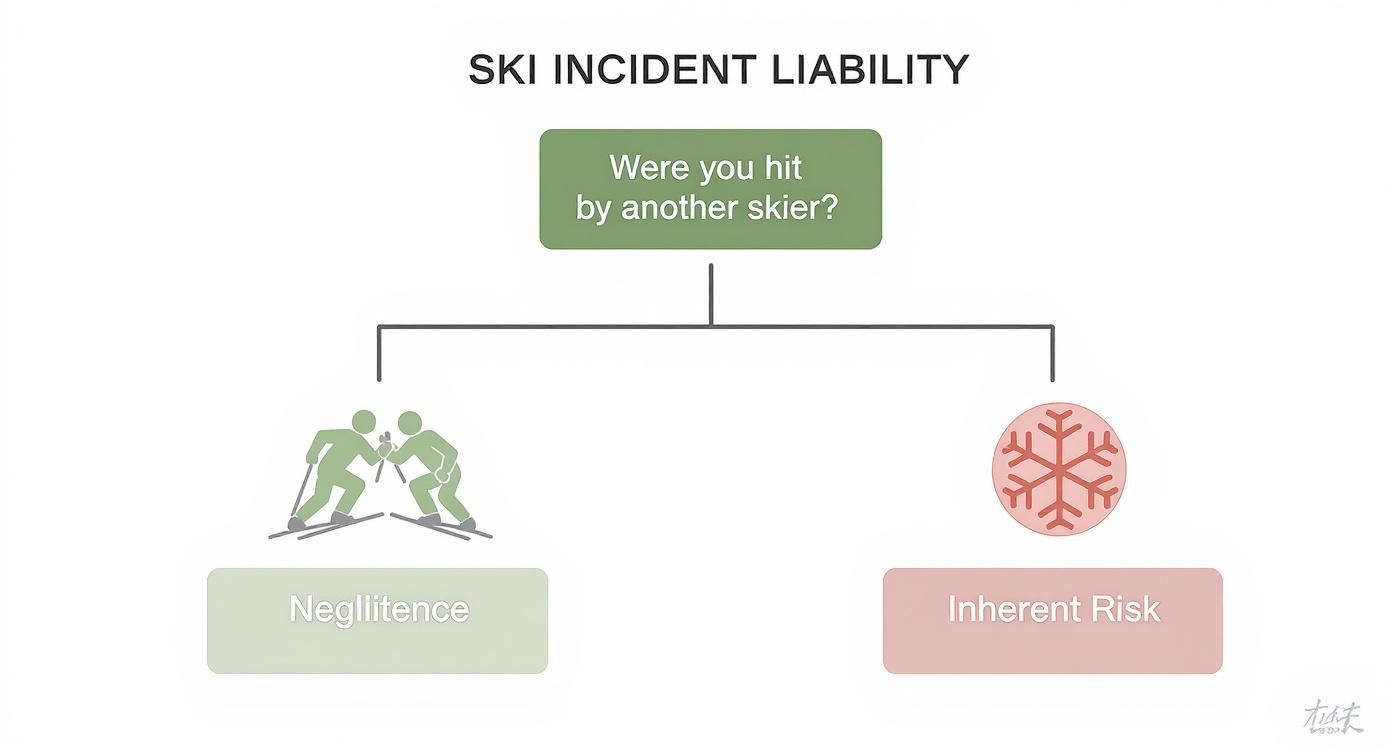
Yes, you assume certain risks. The waiver you clicked “agree” on protects resorts from lawsuits over the “inherent dangers and risks of skiing.” These are things that are just part of the sport itself.
- Changing Weather/Snow Conditions: Ice patches, heavy powder, spring slush.
- Natural Terrain: Bumps, moguls, trees, rocks.
- Man-Made Structures: Lift towers, snowmaking equipment, trail signs.
Notice what’s missing? Another human being flying down the mountain out of control. That is never an inherent risk.
The Rule That Defines Your Lawsuit
The most powerful part of the Ski Safety Act is Section 33-44-109. This is the foundation for almost every successful reckless skier lawsuit in Colorado. It states, unequivocally:
The downhill skier has the right-of-way. The uphill skier has the primary duty to avoid a collision with any person or object below them.
This isn’t a friendly suggestion—it’s an absolute legal obligation. It makes proving fault in a skier-on-skier collision far more straightforward than in a car accident. If someone hits you from uphill, the law presumes they are at fault. Their failure is negligence.
Two Paths to Compensation After a Collision
When you’re recovering, you need clarity, not complexity. Your case will likely follow one of two paths—suing the skier who hit you, or suing the resort. Let’s be direct: suing the other skier is, by far, the most common and effective route.
Path A: Suing Another Skier (The Most Common Path)
You aren’t trying to ruin someone’s life. You are making a claim against their homeowner’s or umbrella insurance policy.
These policies almost always cover negligent acts, even ones that happen on a mountain in Breckenridge or Aspen. This is what insurance is for. We make their insurance company pay for the damage their client caused.
To do that, evidence is everything. We need to lock down:
- Witness Information: Names and numbers from anyone who saw the crash.
- The Ski Patrol Report: This is the cornerstone—it should identify the at-fault party.
- Helmet Cam Footage: Your footage, their footage, or a bystander’s footage can win the case outright.
Path B: Suing the Resort (The Steeper Path)
This is a tougher, more complex fight. To win, you have to prove the resort’s negligence was so egregious that it punches right through their liability waiver.
It’s rare, but possible, in specific situations like:
- Improperly marked hazards or construction zones.
- Negligence by a lift operator causing injury.
- A direct malfunction of resort equipment, like a chairlift.
Proving these cases requires a deep understanding of the narrow exceptions carved out in Colorado law. It’s a fight, but it’s a fight that can be won.
Your Catastrophic Injuries Demand Serious Representation
A ski collision isn’t a fender bender. An impact at 30 mph—a standard speed on an open run at Breckenridge—generates a staggering amount of force. These are high-velocity impacts that cause life-altering injuries.
Your case must be handled with the seriousness it deserves from day one.
The Invisible Injury: Traumatic Brain Injury (TBI)
A broken leg is obvious. A Traumatic Brain Injury (TBI) is not. Its devastating effects on your memory, personality, and ability to earn a living might not surface for weeks.
An insurance adjuster will try to rush you into a quick, lowball settlement before anyone knows the true scope of your TBI. They know that what seems like a “simple concussion” can spiral into a lifetime of cognitive struggles. Accepting that first offer is a catastrophic mistake.
Spinal Cord Injuries and a Lifetime of Care
The same forces that cause a TBI can just as easily inflict permanent damage on the spinal cord. A spinal injury demands a legal strategy built for one thing: securing a recovery that can cover a lifetime of complex medical needs, home modifications, and lost earning capacity.
The insurance company will try to minimize your future needs. We will not let them.
What You Must Do Immediately After A Ski Collision
The moments after a crash are a chaotic blur. But the actions you take in the first 30 minutes can make or break your entire case. Documented facts are everything.
Rule #1: Wait for Ski Patrol
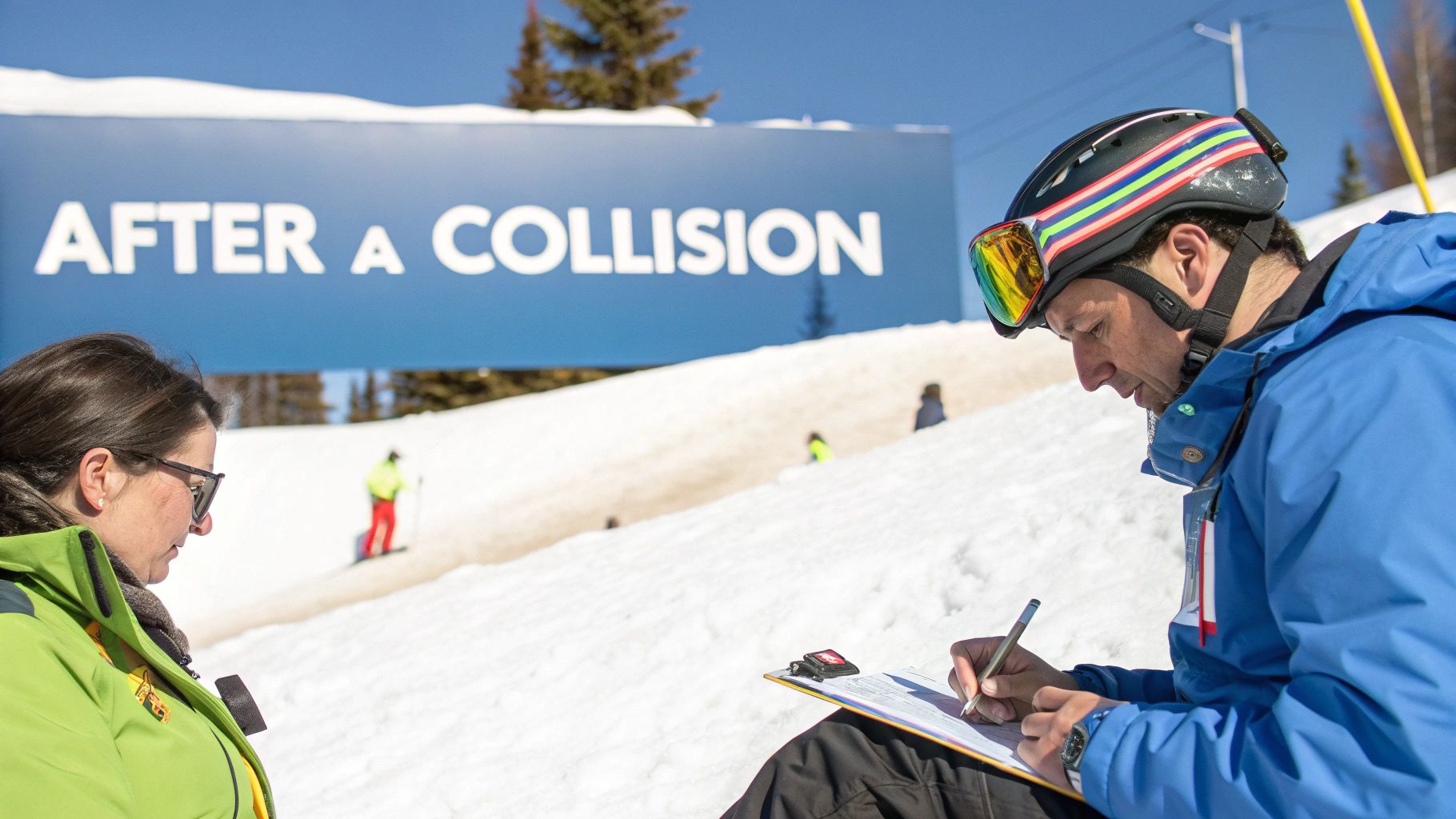
No matter what, do not leave the scene. Even if the other skier is apologetic, you must wait for Ski Patrol to arrive and file an official report. Leaving is the single biggest mistake you can make.
Rule #2: Get Their Information
Insist that the Ski Patrol report includes the full name, phone number, and pass information of the other skier. If you can, take a picture of their driver’s license or season pass yourself.
A verbal apology at the scene is worthless in court. A Ski Patrol report identifying the at-fault party is pure gold.
Rule #3: Preserve Your Gear
Your cracked helmet, broken skis, and torn jacket are now critical evidence. Do not give them away. They are tangible proof of the force of the impact—proof the insurance company cannot ignore.
Why Your Lawyer Must Be a Colorado Law Firm
Any personal injury lawyer can add “ski accidents” to their website. That doesn’t mean they know the first thing about winning one.
A generalist won’t understand the specific legal precedents that shape the Colorado Ski Safety Act. They won’t know the difference between the expert terrain at Aspen and the high-traffic intermediate runs at Keystone where collisions are tragically common. We do.
Your future is too important to entrust to someone learning on the job. We know the mountains, we know the law, and we know exactly what it takes to win.
Disclaimer: The information in this blog post (“post”) is provided for general informational purposes only and may not reflect the current law in your jurisdiction. No information in this post should be construed as legal advice from Conduit Law, LLC or the individual author, nor is it intended to be a substitute for legal counsel on any subject matter. No reader of this post should act or refrain from acting based on any information included in, or accessible through, this post without seeking the appropriate legal or other professional advice on the particular facts and circumstances at issue from a lawyer licensed in the recipient’s state, country or other appropriate licensing jurisdiction.
The call is free. The advice is critical. I got you. Call Conduit Law for a free consultation.
Written by
Conduit Law
Personal injury attorney at Conduit Law, dedicated to helping Colorado accident victims get the compensation they deserve.
Learn more about our team

