

Table of Contents
The insurance adjuster has a script. A neat little story where the villain isn't their client who was driving too fast on bald tires—it's the weather. They’ll call the crash an “Act of God” and tell you everyone shares the blame when the roads get slick.
Let's get one thing straight, right now: Icy roads are not a legal excuse for reckless driving.
This isn't just a turn of phrase. It’s the entire foundation of your case. As an icy road car accident attorney in Colorado, my job is to dismantle their convenient fiction with cold, hard, inconvenient facts. Negligence isn't excused by freezing temperatures—it’s exposed by it.
The “Unavoidable Accident” Is the Oldest Lie in the Book
You saw it before they did. That weird, dark shimmer on the asphalt—the tell-tale sign of black ice on an otherwise clear day. You did what any responsible Colorado driver does: you eased off the gas, kept the wheel steady, and gave yourself space.
The driver behind you, however, was in a different world—a world where physics apparently takes a snow day. They were tailgating, probably texting, and definitely not paying attention to the road ahead.
When you slowed, their sedan went into a clumsy pirouette and slammed into your rear bumper. The first words out of their mouth weren't "Are you okay?" They were, "The ice! I couldn't stop. It was unavoidable."
This is a lie. A tired, predictable, self-serving lie. It’s the go-to excuse for every driver who thinks a Colorado winter is just a suggestion—and it’s the first page in the insurance adjuster’s playbook. They want you to believe this was a random act of nature, a blameless event.
It wasn't. It was a choice. Their choice.
Your Case Is Won by Proving Their Negligence Was the Real Hazard
The other driver already has their story straight. "The ice came out of nowhere," they'll tell their insurer. "I did my best, there was nothing anyone could do."
It's a convenient story that erases all responsibility. And it’s almost never true. Our job is to dismantle that narrative with objective, cold, hard facts.
Proving negligence in a winter crash means showing the other driver breached their duty of care. That’s the non-negotiable legal obligation every single person has to drive in a way that’s reasonable and prudent for the current conditions. When they blame the ice—they’re basically confessing they failed to do just that.
Your Secret Weapon: Their Bad Tires
A driver who gets behind the wheel with bald tires on a snowy day is no different than one who drives drunk. They are knowingly operating a dangerous machine without the equipment to control it. That’s a willful act of negligence—and it’s incredibly powerful evidence.
We aggressively investigate the condition of their vehicle:
- Tire Tread Analysis: We get the tread depth measured. If it’s below the legal minimum/obviously inadequate for winter conditions, their “unavoidable accident” defense evaporates.
- Maintenance Records: We subpoena service records. Did they ignore a mechanic’s recommendation to get new tires?
- Chain Law Violations: Did the crash happen on a stretch of I-70 where the Colorado Traction Law was active? Failing to use chains/proper tires is negligence, full stop.
The Truth Is in the Weather Data
The "surprise" of black ice is rarely a legitimate surprise. Weather forecasts, roadside temperature displays, and visible ice on overpasses are all clear warnings. We use forensic weather reports from the National Weather Service to prove exactly what the conditions were at the precise time and location of the crash.
We pull CDOT camera footage and traffic alerts. We paint a picture that any reasonable driver would have—and should have—been on high alert. Their failure to heed those obvious warnings was their negligence, and that negligence is what caused your harm.
We Know How to Dissect Colorado’s Worst Winter Crashes
https://www.youtube.com/embed/TZQXuWzBC18
The insurance adjuster wants to lump every winter collision into a single, blameless category called "bad weather." But the chaos on I-25 during the first snow is a whole different beast from a black ice spinout on a mountain pass. I’ve handled these scenarios hundreds of times—they are tragically predictable.
Scenario A: The Rear-End Collision on Ice
This is the classic. You do everything right. Then, BAM. The driver behind you slams into your trunk, immediately blaming the ice.
This is a confession, not a defense. It’s a direct admission they were following too closely for the conditions. Colorado law is clear: every driver must maintain a safe following distance, which expands dramatically on ice. The standard three-second rule becomes an eight- to ten-second necessity.
Scenario B: The Loss-of-Control Spinout
A car in the next lane loses traction, spins, and careens into you. The other driver will claim they were helpless.
This points directly to negligence. Vehicles don't just spontaneously lose control. They lose control because they are moving too fast for the conditions. The spinout itself is powerful evidence of excessive speed.
Scenario C: The I-70/I-25 Multi-Car Pileup
These chain-reaction wrecks that shut down I-70 or I-25 feel impossibly chaotic. But figuring out fault isn't impossible—it’s just complicated.
The process involves meticulously reconstructing the sequence of events to find the first negligent act that set off the chain reaction. Was it a trucker going too fast for the grade? A driver on bald tires who spun out?
Investigating these pileups requires an icy road car accident attorney in Colorado with the resources to immediately secure all police reports, interview dozens of witnesses, and hire accident reconstruction experts to analyze the physics of each impact. The insurance company's dream is chaos; our job is to find the clarity that gets you paid.
The Playbook Insurance Companies Use to Cheat You
Right after the crash, you’ll get a call from the other driver’s insurance adjuster. They will sound impossibly calm and reasonable. Don't be fooled. Every word is part of a script designed to save their company money by taking it from you.
Their entire strategy is built on one dishonest idea: that the ice makes everything confusing and, ultimately, a shared problem. They want you to feel uncertain and grateful for whatever they offer.
They will tell you everyone is at fault because of the ice.
This line is their ace in the hole. They use it to justify a ridiculously low offer, claiming that since everyone was sliding, everyone shares a piece of the blame. It’s a cynical distortion of how the law works. Negligence isn't erased by freezing temperatures; it's magnified by them.
Then, they’ll downplay your injuries and rush you to settle. They want your signature before you’ve seen a doctor, before you understand the true cost of your medical bills, and certainly before you’ve called a lawyer.
They will tell you everyone is at fault because of the ice. Don't believe them.
The adjuster’s first offer is never their best offer. It is the lowest number they think you might be desperate/uninformed enough to accept. Recognizing their game is the first step to beating them at it.
Your Job at the Scene: Preserve the Melting Evidence
The moments after a crash are chaos. Your adrenaline is pumping. But in this chaos, evidence is literally melting away. What you do next can make or break your entire case.
- Rule #1: Take Pictures of Their Tires. I cannot overstate this. Get close-up, clear photos of the tread on all four of the other driver's tires. A photo of bald tires on a snowy day can single-handedly dismantle their "unavoidable accident" defense.
- Document Everything. Take wide shots showing the final resting positions of all vehicles and the road conditions. Capture photos of the specific patch of ice they’re blaming. Get detailed pictures of the damage to both vehicles.
- Get Witness Info. A neutral third party who saw the other driver speeding or tailgating is an invaluable asset. Get their name and number.
- Get Medical Attention. Even if you feel fine, adrenaline can mask serious injuries like whiplash or a concussion. A medical record from the day of the crash creates a direct link between the collision and your injuries.
The insurance company has a predictable three-step playbook they almost always follow, as you can see below.
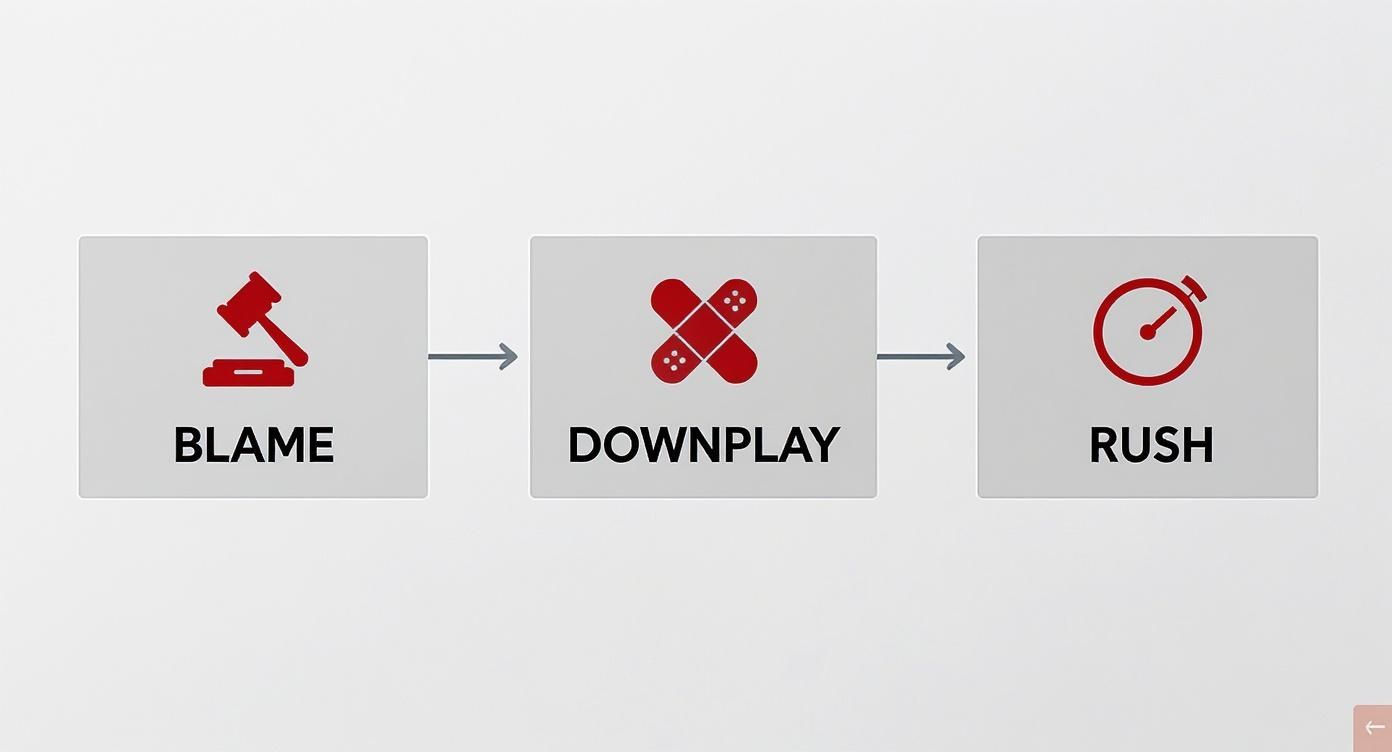
This process—blame the conditions, downplay your injuries, and rush you into a quick, lowball settlement—is designed to protect their profits, not you.
In Colorado, our roads present unique dangers. The I-70 corridor between Vail and Glenwood Springs saw over 300 crashes in 2024, many linked to black ice. Denver's I-25 experienced 1,200 crashes in the same period, often caused by distraction and slick conditions. These numbers show that what seems like an "accident" is often part of a predictable—and preventable—pattern.
Disclaimer: This blog post is for informational purposes only and does not constitute legal advice. The information provided does not create an attorney-client relationship. Past results do not guarantee future outcomes.
At Conduit Law, we cut through the noise. The insurance company has a script—we have a strategy built on facts. If you were hurt because another driver refused to respect a Colorado winter, let’s talk. I got you. Call us for a free, no-obligation case evaluation.
Written by
Conduit Law
Personal injury attorney at Conduit Law, dedicated to helping Colorado accident victims get the compensation they deserve.
Learn more about our team

