Table of Contents
When you lose someone you love, the world grinds to a halt. Everything stops—except the clock. Suddenly, you’re thrown into a legal world you never asked to join, a world with its own brutal rhythm and a pace that feels agonizingly slow.
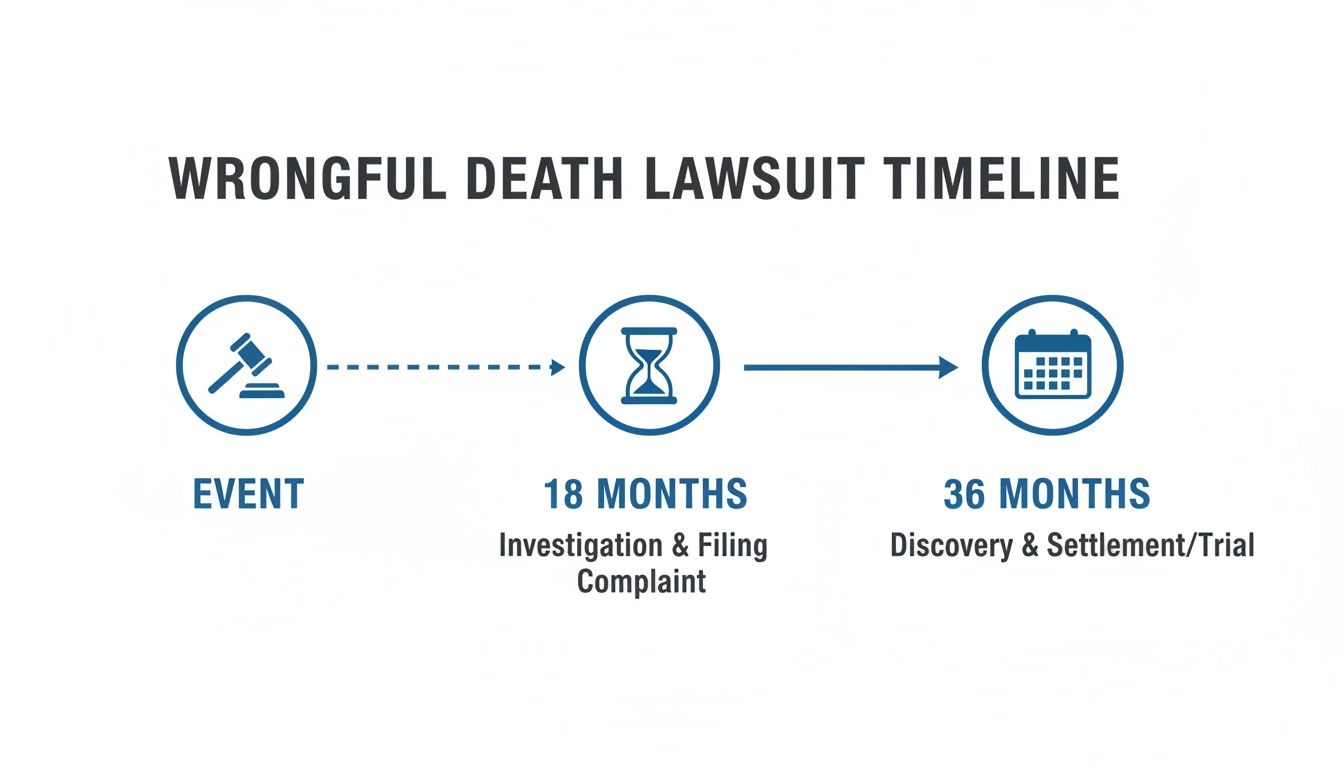
So let’s get straight to it. The average wrongful death lawsuit timeline Colorado runs somewhere between 18 and 36 months. That number isn't a sign of neglect or a case getting lost in the shuffle. It's the deliberate, methodical process required to dismantle the arguments of an insurance company that is banking on your grief—counting on your exhaustion—to force a quick, cheap settlement.
This isn’t a passive waiting game. It’s a strategic war of attrition. We use that time to build an unassailable case. We control the clock, providing your family with predictable, compassionate communication while we prepare for the fight. Understanding this timeline isn’t just for your peace of mind; it’s the first step in taking back control.
Your First Job Is Protecting Your Right to Have a Timeline
While the full lawsuit takes years, your right to file it is governed by a series of short, vicious, non-negotiable deadlines. These are the tripwires. They are unforgiving.
This is where we come in. Our first job isn't to talk about settlement values—it's to become your critical deadline specialist. We immediately identify and neutralize every statutory time bomb set to go off in the background.
Missing one of these deadlines—and some are terrifyingly short—means your case is over before it even begins. Game over. The insurance company wins by default. We don't let that happen.
Phase 1: Pre-Litigation and Investigation (1–6 Months)
The moment a loved one is lost, a series of invisible timers start counting down. This first phase is a sprint—a controlled, strategic sprint—to preserve your family's rights while gathering the evidence needed to win.
We have to move with deliberate urgency. Not to rush you, but to protect you from a system that will not wait for you to grieve.
The Deadlines We Disarm Immediately
This is our entire focus from day one. These are the deadlines the insurance company hopes you don't know about.
- The 182-Day CGIA Notice: If a government entity is involved—a city bus, a poorly maintained public road, a state employee—you have a razor-thin 182 days to file a formal Notice of Claim under the Colorado Governmental Immunity Act. It's one of the most brutal deadlines in Colorado law.
- The 1-Year Dram Shop Deadline: If a bar or restaurant over-served the at-fault person, we have just one year to put them on formal notice. A day late, and that claim vanishes. A fatal drunk driving accident lawyer Denver lives and breathes this deadline.
- The 2-Year Statute of Limitations (SOL): For most wrongful death cases, you have two years from the date of death to file a lawsuit. It sounds like a lot of time—it isn't. You can read our deep dive into the Colorado wrongful death statute of limitations here.
While managing this clock, we’re also launching a full-scale investigation, sending demand letters to preserve evidence, and finalizing the crucial question of who can file a wrongful death claim in Colorado. This phase lays the entire foundation for your case.
Phase 2: The Long Fight of Litigation and Discovery (12–18 Months)

This is where the battle is truly joined. After filing the formal Complaint and officially suing for wrongful death in Colorado, we enter the longest and most intensive phase: Discovery.
This isn't a courtroom drama—it's a strategic intelligence operation. The defense has documents, emails, and testimony they'd rather keep buried. Discovery is our legal authority to force it all into the light. It’s where a longer timeline often correlates with a higher settlement value.
Our Tools for Forcing the Truth
We deploy a full legal arsenal to extract every relevant fact and dismantle the other side's case.
- Interrogatories: Written questions the defendant must answer under oath.
- Requests for Production: A formal demand for every document, email, or record related to the case.
- Requests for Admission: A list of facts the other side must admit or deny, narrowing the issues for trial.
- Depositions: Live, sworn testimony where we question defendants and key witnesses face-to-face. There is no hiding in a deposition.
Simultaneously, we hire our own team of experts—forensic economists who calculate the full financial devastation of your loss—to build a precise, defensible damages model that insurance companies cannot ignore. This hard, grinding work is what gives us the leverage to win.
Phase 3: The Endgame of Settlement, Mediation, or Trial (6–12 Months)
After months of building our case brick by brick, we enter the endgame. Over 95% of wrongful death cases resolve in this phase, almost always through a formal process called mediation.
Mediation is a structured negotiation run by a neutral third party, usually a retired judge. It’s where we lay all our cards on the table—the expert reports, the damning deposition testimony, the undeniable proof.
It’s where we make the insurance company stare directly at the risk of losing badly in front of a jury.
The Worst Insurance Tactic: The Courthouse Steps Offer
But you need to be prepared for their favorite game. Insurance companies will often wait until the last possible second—sometimes literally on the courthouse steps before a trial begins—to make a fair offer.
This is a calculated psychological tactic. It’s designed to test our resolve and prey on your exhaustion. They want to see if we’ll blink.
We don’t blink. We anticipate this move, we plan for it, and we never let it intimidate us into taking a dollar less than your family is owed. This cynical game of waiting until the eve of trial is a deliberate strategy to wear you down, and we will not let it work.
Phase 4: The Final Wait—Post-Settlement Distribution (1–6 Months)

Reaching a settlement agreement feels like the finish line, but it’s not. The check doesn't just show up tomorrow. This final phase, lasting one to six months, is where our job shifts to maximizing the net recovery that actually reaches your family.
First, we aggressively negotiate down any outstanding medical liens from hospitals, health insurers, or Medicare/Medicaid. Every dollar we save them is a dollar that goes directly to you.
The Judicial Gatekeeper: Why Probate Court Is Vital
Next, and most importantly, we must petition the Probate Court for final approval. In Colorado, a wrongful death settlement isn't legally final until a judge signs off on it.
This is not a rubber stamp—it’s a crucial protection. The judge acts as a gatekeeper to ensure the wrongful death settlement distribution Colorado is fair and legally sound, especially when the interests of minor children are at stake. We handle this entire complex process, securing the court order that finally allows the funds to be disbursed. This vital step adds time, but it provides an essential layer of legal and financial protection.
While this guide focuses on the lawsuit timeline, you may want to learn more about how Colorado calculates damages in these cases. And if you're curious about timelines in other injury cases, you can read our guide on how long a personal injury case should take to settle.
The Value of Controlling the Clock
The entire wrongful death lawsuit timeline Colorado is a strategic battlefield. The insurance company wants to rush you into a bad decision. We control the pace to build leverage, ensuring you make a fully informed decision when the time is right.
But it all starts with protecting your right to have a timeline in the first place. Those initial statutory deadlines are everything. Miss them, and your fight is over.
Your only job right now is to focus on your family. Let us take on the fight. Let us handle the deadlines. Let us carry the legal burden for you.
We got you.
Disclaimer: This blog post is for informational purposes only and does not constitute legal advice. The information provided is not a substitute for consulting with a qualified attorney. The specific facts of your case will determine the best course of action. No attorney-client relationship is formed by reading this post or contacting Conduit Law without a signed engagement agreement.
If you’ve lost a loved one due to someone else's negligence in Colorado, the clock is already ticking. Call Conduit Law for a free, no-obligation consultation to understand your rights and protect your family's future.
Written by
Conduit Law
Personal injury attorney at Conduit Law, dedicated to helping Colorado accident victims get the compensation they deserve.
Learn more about our team