Table of Contents
You were hurt in a Lyft on your way to DIA, downtown, or just home—and now you’re staring at a mountain of medical bills and a phone that won’t stop ringing. You need a Lyft accident attorney in Denver who gets it.
Here's the truth they don’t want you to know: as a passenger, your claim for compensation is one of the strongest in personal injury law. You are almost certainly 0% at fault.
The legal fight isn’t about proving who was negligent. It’s about forcing a massive corporation to acknowledge its responsibility and unlock the high-limit commercial insurance policy that Colorado law says you are owed. This isn’t a battle over blame—it’s a battle over access. And it's a battle we know how to win.
The Trick Insurance Companies Don’t Want You to Know
Forget everything else for a moment. In a Lyft accident, one detail dictates the entire direction of your claim: the driver's status in the app when the crash happened.
This isn’t some minor technicality—it’s the master key that unlocks the insurance policy you’re entitled to. Colorado law sets up a tiered insurance system based entirely on this status, and you can bet Lyft’s corporate adjusters will do everything they can to argue you into a lower tier with less coverage.
The Three Tiers of Lyft Insurance: Status Is Everything
Let's be clear—this system is designed to protect Lyft first and you second. Here’s how it works.
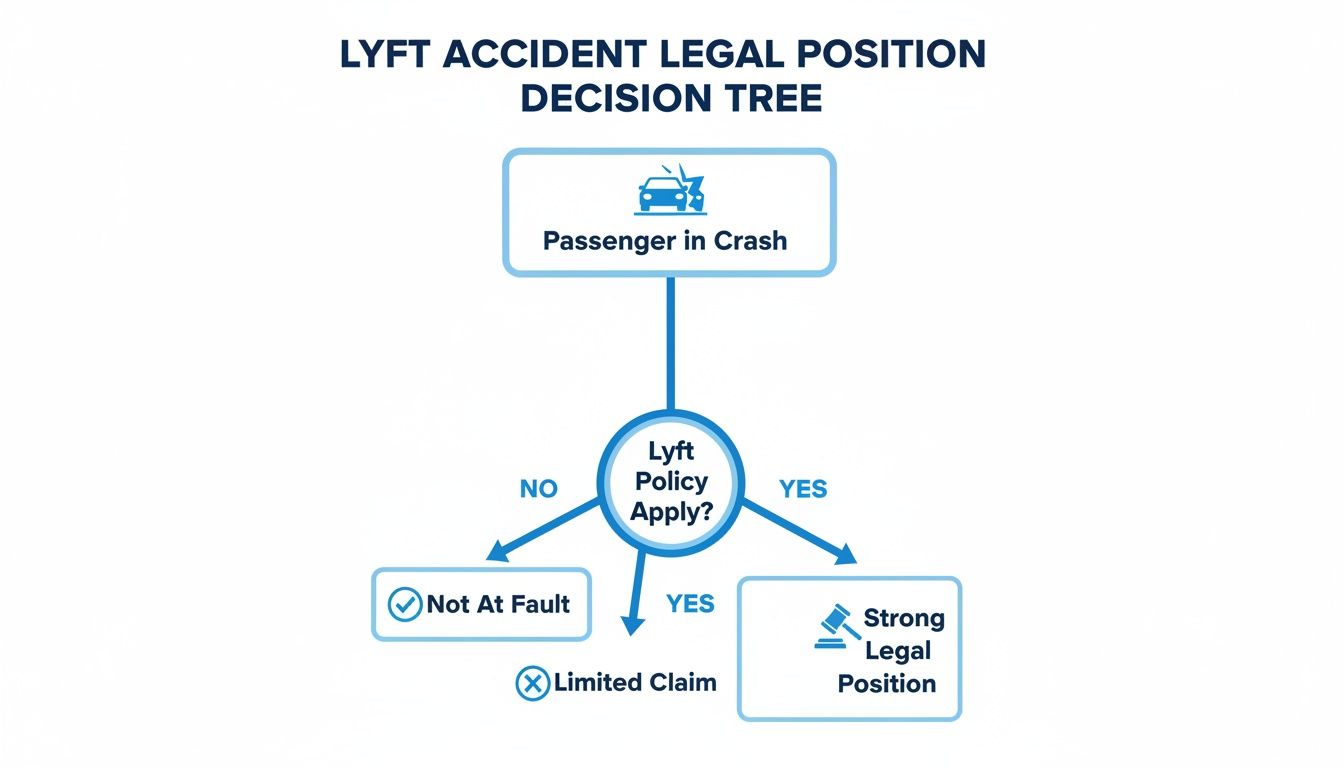
- Tier 0 (App Off): If the driver’s app is off, they’re just another citizen. Only their personal auto insurance applies—which will almost certainly deny your claim because of a “commercial use exclusion.” You get nothing.
- Tier 1 (App On, Waiting for a Ride): When a driver is logged in but waiting for a ping, a small contingent policy from Lyft kicks in. This provides just $50,000 per person / $100,000 per accident in liability coverage. Not nearly enough for a serious Denver crash.
- Tier 3 (Active Ride / En Route to You): This is the one. The moment the driver accepts your request until you are dropped off, Lyft’s full $1 Million commercial liability policy is active.
Your Most Powerful Piece of Evidence
The single most important action you can take after a crash is to screenshot your ride details in the Lyft app immediately.
That screenshot—showing the driver’s name, their car, and the active trip status—becomes the irrefutable proof we need to lock your claim into Tier 3. It shuts down any attempt by adjusters to argue the driver was “off the clock.” They hate this. We love it.
Without that digital proof, you give their corporate lawyers an opening to downgrade your claim. As your Lyft accident attorney in Denver, we’ll use that screenshot to force the conversation directly to the $1 million policy from day one.
You Have Three Paths to Financial Recovery—Here’s How We Choose
Insurance companies love confusion. Their business model depends on it. So, let’s make this simple.
After a Lyft crash in Denver, there are only three ways to get compensated. The path we take is determined by one question: Who caused the wreck?
This isn’t guesswork. It’s a calculated legal strategy based on the specific facts of your crash—and we are experts at coordinating with Denver PD reports and the local court system to establish fault. We pinpoint the at-fault driver, then go after the insurance policy that provides the most complete recovery.
Avenue 1: Your Lyft Driver Caused The Crash
If your Lyft driver ran a red light, made a boneheaded turn, or was otherwise negligent—the path is direct. We file a claim against Lyft’s massive $1 million commercial liability policy.
Since you were an active passenger, Lyft’s insurance is legally on the hook for your damages—medical bills, lost wages, and your pain and suffering. This is the Tier 3 coverage we lock in.
Avenue 2: Another Driver Hit Your Lyft
What if a third-party driver T-bones your Lyft in an intersection? In this case, the first move is to file a claim against that other driver’s personal auto insurance.
But this road has a huge pothole. What happens if that driver only has Colorado's laughably low minimum insurance—or worse, no insurance at all? This is where the third avenue becomes your critical safety net.
Avenue 3: The UM/UIM Safety Net
This is the protection insurance companies hope you don’t know about. Thanks to Colorado House Bill 22-1089, Lyft is required to carry a significant amount of Uninsured/Underinsured Motorist (UM/UIM) coverage for you.
This is a game-changer. If the driver who hit your Lyft is uninsured or their policy is too small to cover your damages, we pivot. We file a UM/UIM claim directly against Lyft's own insurance policy—which provides at least $200,000 per person in coverage—giving you a powerful secondary source for compensation.
The risk for passengers is real. Lyft’s own 2020–2022 Safety Transparency Report revealed 111 motor-vehicle fatalities on its U.S. platform during that time. You can read the full report on rideshare safety to see the data for yourself—it’s why having access to every layer of insurance is so critical.
We Shut Down Their Favorite Legal Games Before They Start
Let’s pull back the curtain on the playbook insurance companies use against you—and how we tear it apart. Their adjusters are professional, friendly, and have one ruthless goal: protecting their employer’s bottom line.
Their go-to move is to subtly suggest that you, the passenger, were somehow responsible. It’s a baseless scare tactic called comparative negligence, and it’s designed to make you second-guess your own claim. We shut that down the moment we hear it.

The Single Most Dangerous Insurance Trick
But here’s the one trick they are absolutely counting on you to fall for.
Their number one goal is to get you to give a recorded statement before you talk to a lawyer.
Let me say that again, because it matters. Their number one goal is to get you to give a recorded statement before you know your rights. They will twist your words—innocent apologies, casual remarks, downplaying your pain—to gut the value of your claim. Never give one. Period.
Anticipating Every Angle
Our job as your Lyft accident attorney in Denver is to see their moves coming and build a case that’s just too strong for them to fight.
We investigate every possible angle, not just the crash itself.
- Dram Shop Liability: Was the Lyft driver clearly intoxicated? We’ll find out if a bar over-served them. Under Colorado's Dram Shop Act, that establishment could be liable.
- Road Conditions: Did the accident happen during a nasty Denver winter storm on an icy road? A government entity could share fault.
- Third-Party Negligence: We dig into the history of everyone involved. A history of reckless driving strengthens your claim for damages.
This kind of deep-dive investigation is critical because insurers are experts at defending these claims. You can explore the common reasons why insurance companies might refuse to pay a claim. We’re here to protect your right to full compensation for your medical bills, lost wages, and pain and suffering.
Your Next Move Is Simple, but It's Everything
This is the moment where clarity replaces chaos. What you do next is simple, but it’s also non-negotiable if you want to protect yourself.
You will not speak with any insurance adjuster before you’ve spoken with a lawyer. Not your driver's, not the other driver's, and definitely not some slick corporate rep from Lyft's team. Their job is to protect their company's money—not you.
Do Not Give a Recorded Statement
Insurance adjusters are trained to listen for anything they can twist to deny your claim. They’ll ask leading questions and use your politeness against you. A simple, "I'm okay" becomes their Exhibit A for why your injuries aren't serious.
Let us handle them. This is a mess, but it’s a calculated mess we know how to dismantle. The second you get a call, your response is firm: "I'm being represented by counsel. You can direct all communication to my attorney." Then hang up.
Let Us Take Control
We’ll step in and manage every single communication. We’ll collect the police report, secure your medical records, and start gathering the evidence to build a powerful case. If there were witnesses, we’ll track them down and get their statements—you can learn about how to write a witness statement to see what makes one effective.
This is what we do. We put ourselves between you and the insurance machine so you can focus on getting better. You’ve been through enough.
Disclaimer: This blog post is for informational purposes only and does not constitute legal advice. The information provided does not create an attorney-client relationship. Every case is different, and past results do not guarantee future outcomes.
A Lyft accident turns your life upside down in an instant. You don't have to navigate the corporate insurance maze alone. I'll handle the adjusters and the legal fight—you focus on your recovery. Call Conduit Law for a free, no-obligation consultation to understand your rights and options. I got you.
Written by
Conduit Law
Personal injury attorney at Conduit Law, dedicated to helping Colorado accident victims get the compensation they deserve.
Learn more about our team