Table of Contents
You did everything right. Paid your premiums on time, month after month. You even sprang for Uninsured/Underinsured Motorist (UM/UIM) coverage—that expensive line item your agent swore was your ultimate safety net.
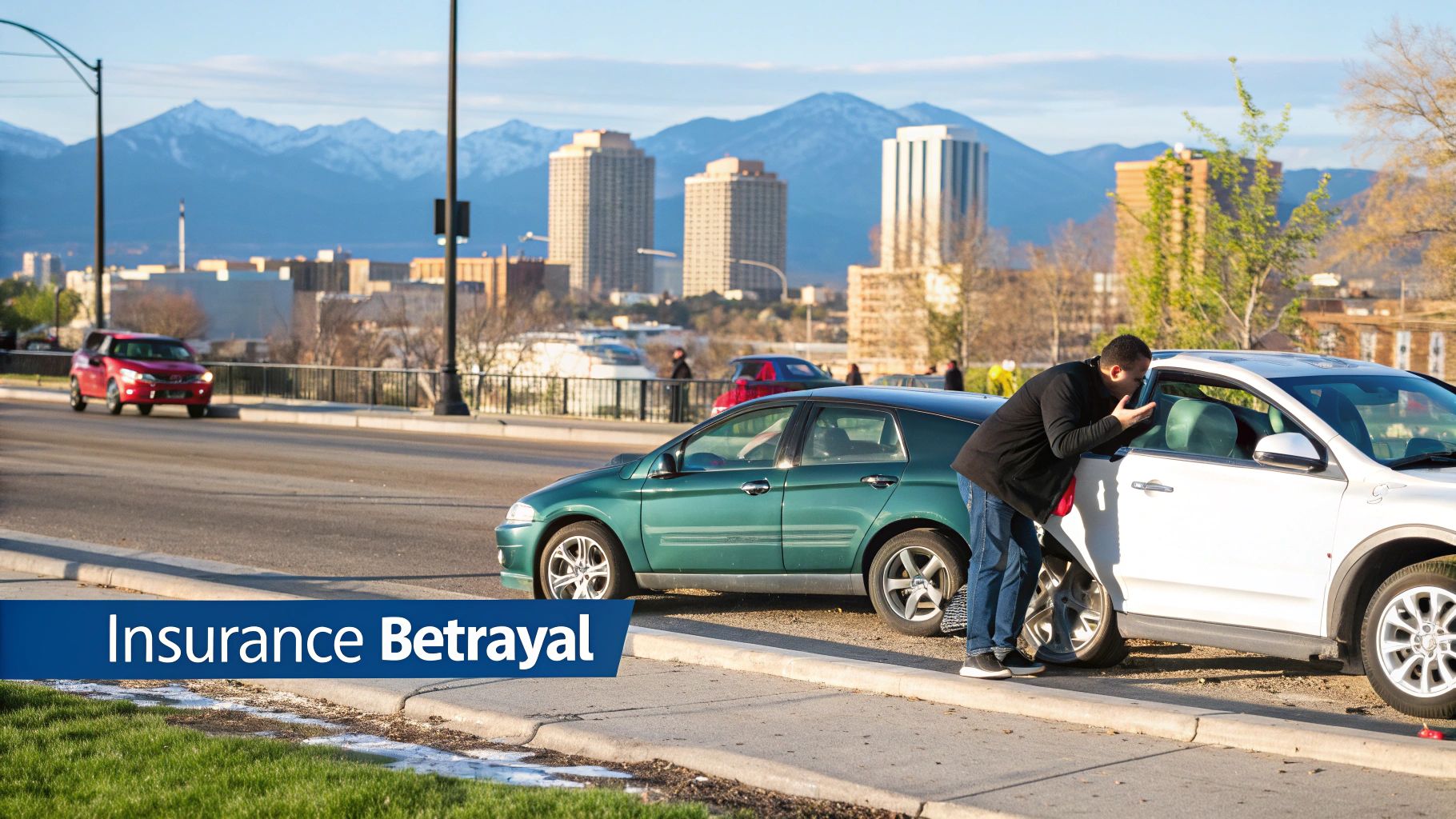
Then it happens. A crash on I-25. The other driver—one of the nearly 20% of Colorado motorists driving illegally without insurance—leaves you with a wrecked car and a mountain of medical bills.
You call the insurance company whose jingle promises you’re in “good hands.” You expect help. Instead, you get the runaround. This is the great betrayal. The moment you file a claim, your protector becomes your opponent. Their goal is now singular and ruthless: pay you as little as humanly possible. This is not a partnership; it’s a fight. And you need an uninsured motorist lawyer Denver drivers can trust to fight it.
They are betting you’re too hurt, too tired, and too intimidated to push back.
They’re wrong.
The Trick Insurance Companies Don’t Want You to Know
Let's get one thing straight—your UM/UIM policy isn’t a favor. It’s a contract. A legal weapon you paid for. But it’s only powerful if you know how to wield it.
Most people don’t. Insurance companies count on that. They love to muddy the waters between the two types of coverage.
- Uninsured Motorist (UM): This covers you when the at-fault driver has zero insurance, or when it’s a hit-and-run and they simply vanish.
- Underinsured Motorist (UIM): This kicks in when the at-fault driver has insurance, but their policy limits are pathetically low—too low to cover your serious injuries.
Either way, you’re now facing a two-front war.
The Absurd Burden of Suing Yourself
To win, you have to clear two hurdles, and your own insurer will fight you every step of the way. It’s a perverse setup.
- Prove the Other Driver Was at Fault: First, you have to establish the other driver's negligence—that they caused the crash through carelessness. Standard stuff.
- Prove Your Damages to Your Insurer: This is the brutal part. You then have to prove the full value of your damages to your own insurance company. They literally step into the shoes of the person who hit you, arguing your injuries aren’t that bad/that you don’t need the treatment your doctors recommend.
It's a process designed to crush you. The company you paid to protect you is now financially incentivized to tear your life apart.
The Mandatory Offer You Forgot You Had
Here’s a crucial piece of Colorado law. Insurers are required to offer you UM/UIM coverage. If you want to decline it, you must do so in writing. Many people never signed that waiver.
An experienced uninsured motorist lawyer in Denver knows to demand proof of that signed rejection. If they can’t produce it, you have coverage. This is just one of many Colorado auto insurance requirements they hope you don’t know about.
Your Insurer Hates When We Use This Strategy

Insurance policies are intentionally dense and confusing. They’re banking on you not knowing the rules of the game. One of their best-kept secrets is a powerful legal strategy called stacking.
Imagine you have two cars on your policy, each with a $100,000 UM limit. After a crash, the adjuster will only talk about the $100,000 for the car you were driving. They will conveniently forget to mention that Colorado law often lets us combine—or "stack"—the coverage from your other vehicle.
Just like that, you have a $200,000 pool of funds. Your insurer will never tell you this. Our job is to find every dollar and make them pay it.
Finding Hidden Pockets of Money
Stacking is a legal doctrine allowing us to hunt for every possible source of recovery—often in places you’d never think to look.
- Intra-Policy Stacking: Combining the UM/UIM limits for each vehicle listed on a single auto policy.
- Inter-Policy Stacking: Combining coverage from separate auto policies within your household—like yours and your spouse's.
Stacking is not automatic. It requires a precise legal analysis of your policy and current case law. Insurers fight it tooth and nail, but we know the arguments that win.
The Rideshare Connection
Rideshare services add another layer of opportunity. If you’re a passenger in an Uber or Lyft and an uninsured driver hits you on your way through Westminster or Aurora, the rideshare company's insurance is on the hook.
Colorado law mandates companies like Uber and Lyft carry at least $200,000 in UM/UIM coverage for their passengers. This is a critical, often-overlooked source of compensation. Whether you need a Lyft accident attorney in Denver or an Aurora car accident lawyer, the strategy is the same: find every dollar of coverage available.
The Nuclear Option That Can Triple Their Payout 💣
This is it. The ultimate leverage. The move that turns an insurer’s smug delay tactics into a catastrophic financial mistake—for them. It’s called Statutory Bad Faith.
The entire UM/UIM setup is a masterclass in corporate betrayal. The company you paid for protection is now financially incentivized to deny you that protection. Their playbook is predictable: delay, deny, defend. Their goal is to wear you down until you accept a pathetic fraction of what you’re owed. Unreasonable delay is their favorite game.
They’re counting on you not knowing the law. We're counting on them knowing that we do.
The Law and the 3X Penalty
Colorado lawmakers knew insurers needed a reason to behave. So they gave us C.R.S. § 10-3-1116—a statute with serious teeth.
The law is simple but devastatingly powerful. If an insurer unreasonably delays or denies payment of a valid claim, they are acting in “bad faith.” And the consequences are severe. Under this law, you can sue to recover:
- The full amount of the covered benefit.
- PLUS, two times the covered benefit as a penalty.
- PLUS, all reasonable attorney fees and court costs.
Let’s be clear. Your valid $100,000 UM claim becomes a $300,000 payout. This is the 3x recovery potential that changes everything. The mere threat of it—wielded by an insurance bad faith lawyer in Colorado with a reputation for winning—is often enough to turn an unreasonable adjuster into a very reasonable one, very quickly.
Why Every Document Is Ammunition
The key is proving their behavior was unreasonable. This isn’t a simple disagreement. It’s about demonstrating a pattern of conduct that has no legitimate basis.
This is why meticulous documentation is non-negotiable. Every email, every phone call, every flimsy excuse becomes another piece of evidence. Their favorite tactic is unreasonable delay. They know the bills are piling up. They want you to get desperate. We turn that delay into the rope they use to hang themselves in court.
The One Thing You Must Never Do
If you take one piece of advice, let it be this: DO NOT give a recorded statement to your own insurance adjuster before speaking to a lawyer.
Soon after the crash, your phone will ring. The adjuster will sound incredibly friendly. They are not your friend. They are a highly trained professional whose only job is to get you on record downplaying your injuries, implying fault, or creating inconsistencies they can use to deny your claim.
That recorded statement is not a formality. It is the first piece of evidence they will build against you.
- They'll ask, “How are you?” If you say, “I’m okay,” they'll note: “Victim stated they were ‘okay.’”
- They’ll ask you to describe the crash, hoping you say something that suggests even 1% fault, which they can use to slash your payout under Colorado’s comparative negligence rules.
- They’ll ask about old injuries to argue your pain is a pre-existing condition. It’s a classic, cynical move.
When you hire an experienced uninsured motorist lawyer in Denver, you take this weapon out of their hands. We handle all communications. No recorded statement without our guidance. We know their playbook, and we won’t let them use it on you.
What to Expect in a UM Claim
| Claim Stage | The Insurer's Playbook | Your Lawyer's Strategy |
|---|---|---|
| Initial Contact | Push for an immediate recorded statement to trap you. | Block all direct communication. No recorded statement. Ever. |
| Investigation | Conduct a one-sided review to find reasons to deny your claim. | Launch a deep, independent investigation to prove liability and damages. |
| Medical Review | Scour your history for "pre-existing conditions" to invalidate your injuries. | Work with your doctors to build a solid medical narrative connecting all injuries to the crash. |
| Settlement Offer | Make a quick, insulting lowball offer, praying you're desperate enough to take it. | Present a comprehensive demand package backed by evidence and negotiate from a position of strength. |
| Litigation | If you refuse, they drag out the process to wear you down financially and emotionally. | We file a lawsuit—including a Bad Faith claim—without hesitation to force a fair resolution. |
The difference is clear. Without a lawyer, you’re playing their game. With us, you change the game entirely. For a full breakdown, see our guide on the Colorado personal injury claim process.
We’ll Take the Fight From Here
You’ve already been through enough. The crash. The injuries. The stress. The last thing you need is a soul-crushing fight with the same company you paid to protect you.
This is a battle you shouldn't have to fight alone.
Let us take it from here. We’ll handle the adjusters, the paperwork, and the entire legal game plan. Our job is to build a case so airtight that your insurer has two choices: pay what you're owed now, or pay triple later. You can put your energy where it belongs—getting better.
The reality is stark: with Colorado’s uninsured driver rate at nearly 20%, you need this protection. You can discover more about the risks on Denver's roads and see just how critical this coverage is.
This is what we do. The consultation is free. We only get paid if you win.
The information contained in this blog post is for informational purposes only and does not constitute legal advice. No attorney-client relationship is formed by reading or interacting with this content. If you have been injured, you should consult with a qualified attorney to discuss your specific situation.
I know how overwhelming this all is. But you don’t have to go through it alone. Call us for a free, no-pressure consultation. Let’s just talk about what happened and how we can help. I’ve got your back.
Contact Conduit Law today for your free consultation.
Written by
Conduit Law
Personal injury attorney at Conduit Law, dedicated to helping Colorado accident victims get the compensation they deserve.
Learn more about our team