Table of Contents
Let’s be blunt. After the wreck—maybe a T-bone on Speer that left you with a constant, screaming headache—tallying up the medical bills and lost paychecks is the easy part. It’s just math. The real challenge is putting a price on everything else.
How do you put a dollar value on the chronic pain that wakes you up at 3 a.m.? The anxiety that floods your system at every intersection? The quiet fury of not being able to pick up your kid/hike your favorite trail/live the life you had before someone else’s mistake?
This is precisely where insurance adjusters try to erase you. They use formulas and software designed to boil your human experience down to a number—always a low one. But Colorado law just blew the roof off the old limits on what your suffering is worth, and that changes the game completely. A new law just created a $1.5 million opportunity, and knowing how to use it is everything.
This guide answers the one question that matters—how much is my pain and suffering worth in Colorado?—and shows you how we build a case that forces them to see the full, human story of your loss.
Your Pain Has a Price, and Insurance Wants a Discount
It might sound cold, but it’s the brutal reality of personal injury law: your pain has a price. When someone else’s carelessness turns your life upside down, the only tool our legal system has to try and make it right is financial compensation.
The straightforward part of any claim involves adding up things with a clear paper trail—medical bills have dollar signs, lost wages can be calculated from your pay stubs. In legal terms, these are called Economic Damages. They’re objective, simple to prove, and—critically—not capped.
The real fight, however—the area where an insurance company's entire business model is built on lowballing you—is over your non-economic damages. This is the legal term for the human cost of the accident. It’s compensation for everything that doesn't come with a receipt.

Defining the Undefinable
So, what exactly is "pain and suffering" in the eyes of the law? Think of it as compensation for the theft of your well-being. It’s a broad category that covers the very real, non-financial ways an injury destroys your life.
Under Colorado law, this includes a wide spectrum of harm:
- Physical Pain: The immediate and ongoing agony from the injury itself—the searing nerve pain, the back spasms that won't quit, the persistent headaches.
- Emotional Distress: The anxiety, depression, fear, and even PTSD that so often follows a traumatic event. The panic attack you have when a car brakes suddenly in front of you.
- Loss of Enjoyment of Life: A huge one. It’s about not being able to go on your weekend hikes, play with your kids on the floor, or simply sit through a movie without being in pain. It’s the loss of the things that made you you.
- Inconvenience: The endless cycle of doctors' appointments and physical therapy sessions that hijack your schedule. The sheer, frustrating hassle of having your life derailed.
- Disfigurement and Impairment: The permanent scars—both visible and invisible—that serve as a constant reminder of what you went through.
These aren’t just abstract legal ideas; they are your daily reality after an injury. And they have very real value in a claim.
The New $1.5 Million Cap Changes Everything
Let’s get straight to it. This is the single biggest change for injury victims in Colorado right now, and it completely rewrites the rules on what your pain and suffering is worth. A new law, House Bill 24-1472, isn’t some minor legal tweak—it's a seismic shift that gives victims real leverage.
For any case we file on or after January 1, 2025, the cap on your non-economic damages skyrockets to a massive $1,500,000.
Notice that word: filed. This isn't just lawyer-speak; it's a critical strategic detail. The new, much higher cap is tied to the date your lawsuit is officially started with the court, not the date of your accident.
Timing Is Everything
This distinction is a powerful tool. It means an accident that happened in 2024 can fall under the new, far more favorable 2025 cap if we strategically file the lawsuit after January 1st. Knowing how to use this nuance can be the difference between a lowball insurance offer and a recovery that actually reflects what was stolen from you.
Before this change, courts capped non-economic damages at a mere $613,760. But House Bill 24-1472, signed by Governor Polis, blew that limit out of the water. That’s a staggering 140% increase that finally starts to acknowledge the true toll an injury takes. You can dig into the specifics of Colorado's new personal injury damage caps on coloinjurylaw.com.
This isn't just about a bigger number on paper. It’s about leverage. Insurance companies know this new cap is the law of the land, and it completely changes their risk calculation. They know a jury now has the power to award a figure that truly reflects a life turned upside down.
The visual below shows the dramatic shift in Colorado law, which moves from an outdated cap to the new $1.5 million ceiling we can now fight for in serious injury cases.
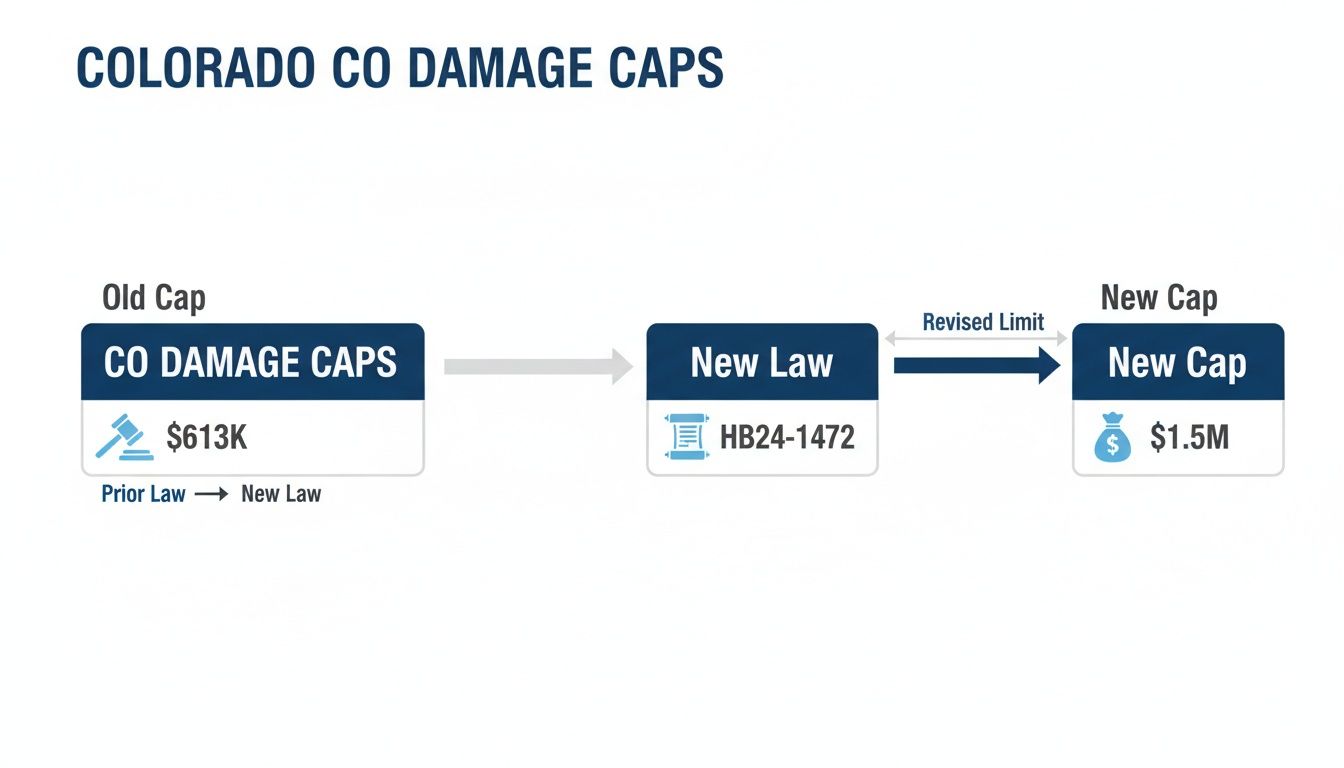
The old cap forced victims to discount their own suffering. The new $1.5 million cap forces insurance companies to face the true, human cost of the negligence they insure.
We build our strategy around this new legal landscape from day one. It shapes how we negotiate, what evidence we gather, and exactly when we file your case. It is the new foundation for building your claim to its maximum possible value.
How We Tell the True Story of Your Suffering
Insurance adjusters love a shortcut. Their favorite is the “multiplier method,” a lazy, dehumanizing formula that pretends your life can be calculated by multiplying your medical bills by two or three.
It's an insult. It’s a deliberate attempt to erase the reality of a life derailed by someone else’s negligence, and it’s a tactic we flat-out reject. Your story is not a math problem to be solved with a cheap formula.
Our approach is different. We don’t play their game. Instead, we build a compelling, evidence-based narrative of your loss. We humanize your pain with objective proof, and we make it impossible for them to ignore. You can read more about their tactics in our guide on how insurance companies calculate settlements.
The Evidence That Builds Your Narrative
How do we make your suffering real to people who have every financial incentive to deny it? We use a multi-pronged approach that leaves no aspect of your post-accident life undocumented.
Here’s a look at what our evidence-gathering looks like in practice:
- Personal Pain Journals: Your own daily words become a powerful, real-time record of your struggles—far more compelling than just recalling your pain months later in a deposition.
- Video Testimonials from Family and Friends: We interview the people who see you every day. Their testimony about the changes in your personality, your loss of joy, and your physical limitations is devastatingly effective.
- Reports from Mental Health Experts: A diagnosis of PTSD, anxiety, or depression from a qualified psychologist provides the objective medical proof of your emotional trauma.
- Vocational Expert Opinions: These specialists can detail the career you lost or the promotions you'll never get, putting a real number on the professional opportunities stolen from you.
Each of these elements works together, layer by layer, to build an airtight case. We transform your subjective experience into an objective reality that a jury can see, feel, and ultimately, value correctly.
The Four Pillars of a Maximum Value Claim
Figuring out how much your pain and suffering is worth in Colorado isn't a matter of luck—and it sure as hell isn't about some lazy insurance adjuster's multiplier formula. A high-value claim is built. It’s constructed, piece by painstaking piece, on a foundation of clear, compelling, and undeniable evidence.
We focus on four pillars to establish the true value of what you've been forced to endure. Each one tells a part of your story, and each one must be methodically proven to force the insurance company to pay what they owe.
1. Severity and Permanence of the Injury
This is the obvious starting point, but the details are everything. A sprained wrist that heals in six weeks is not a traumatic brain injury that leaves you with permanent cognitive deficits. A case involving a few months of whiplash treatment is worlds away from a claim for a herniated disc requiring a spinal fusion.
The more severe, life-altering, and permanent your injuries are, the higher the value of your pain and suffering claim. Our job is to use your medical records and expert testimony to paint a crystal-clear picture of the long-term, irreversible nature of what you’re facing.
2. Duration and Nature of Your Medical Treatment
The length and intensity of your medical journey tell a powerful story of suffering. A few physical therapy sessions are one thing. Multiple surgeries, a series of excruciating epidural injections, and a lifetime of pain management appointments are something else entirely.
The paper trail of your treatment becomes a timeline of your pain—and we often have to fight off healthcare providers who place liens on your settlement. It's a complex issue, but one our firm handles routinely. You can learn more in our guide to medical lien negotiation in Colorado.
3. Objective Proof of Your Subjective Pain
This is where sophisticated lawyering makes a real difference. "Pain" is subjective—only you can truly feel it. Insurance companies love to exploit this, acting as if your suffering isn't real unless a machine can print out a picture of it.
So, we give them pictures. We use concrete, objective medical evidence to give undeniable proof to your invisible injuries. We work with your doctors to get the diagnostic proof that shuts down their arguments:
- MRI and CT Scans: To show the physical reality of a herniated disc or a brain bleed.
- Nerve Conduction Studies (EMG/NCV): To objectively measure the nerve damage causing your radiating pain or numbness.
- Neuropsychological Evaluations: To document the cognitive and emotional fallout from a traumatic brain injury.
This evidence transforms your personal experience of suffering into a scientifically validated fact that an adjuster can't easily dismiss.
4. The Devastating Impact on Your Quality of Life
This is the most crucial pillar—the one that truly defines the human cost of the accident. It’s about everything that was taken from you that doesn't show up on a medical bill. It's the story of the life you lost.
We meticulously document the "before and after." Were you a dedicated runner who can no longer go more than a block without searing back pain? A parent who can no longer pick up their child? This is where testimony from you, your family, and your friends becomes so powerful. This is how we prove what your life is truly worth.
When the Damage Cap Disappears Entirely
The $1.5 million cap on pain and suffering is the general rule, but some actions are so profoundly reckless that Colorado law says the rules just don’t apply. The cap simply disappears.
This powerful exception kicks in when a defendant's conduct was "willful and wanton." This isn't just about a simple mistake or a moment of carelessness. We’re talking about a level of negligence that shows a conscious and depraved indifference to human life. It’s a choice to endanger everyone around you.
Willful and Wanton Conduct: The Drunk Driver
The clearest, most infuriating example is a drunk driver. When someone gets behind the wheel after having too much to drink, they are actively choosing to operate a two-ton weapon on public roads. It's a deliberate disregard for the safety of every other person out there.
If you were hit by a drunk driver, we don’t just argue that the cap should be raised—we argue that it should be eliminated entirely. This opens the door for a jury to award a settlement that truly reflects the catastrophic damage caused by such a selfish act.
This also allows us to pursue punitive damages—damages designed solely to punish the defendant and make an example out of them. A hit by a drunk driver settlement in Colorado must include this element to achieve full justice.
The Stakes in Felonious Killing Cases
The logic of removing caps extends to the most tragic cases of all. When willful and wanton actions lead to a death (felonious killing), the law recognizes that the standard limits are an insult. The pain and grief are immeasurable, and the compensation should reflect that reality.
Starting January 1, 2025, the cap on non-economic damages in wrongful death cases will jump to $2.125 million. You can explore more about the increased damages caps in Colorado on gaddisherd.com. But when the death is caused by willful and wanton conduct, even that cap is eliminated.
When a defendant’s actions are so reckless they defy decency, the law provides a path to justice that goes beyond the standard limits. Our job is to walk that path and demand every dollar you are owed.
In these specific, devastating situations, the normal rules of engagement change. The caps can be lifted, and the potential for a just recovery—one that truly holds the wrongdoer accountable—becomes limitless.
Your First Assignment: Start a Pain Journal. Today.

Here is your first, and most important, assignment. I want you to start a pain and symptoms journal. Today. Right now.
Why? Because it becomes irrefutable, real-time evidence of your suffering. An insurance company can't just dismiss it as an exaggeration you cooked up months later for a lawsuit. A pain journal is your story, in your own words, as it happens—and it is one of the single most powerful pieces of evidence we can use to prove your case.
This is your secret weapon against the adjuster whose job is to pretend your life hasn’t changed. Their favorite tactic is to downplay your suffering. This journal makes that impossible.
How to Create an Effective Pain Journal
You don’t need anything fancy. The notes app on your phone or a simple spiral notebook is perfect. The real key here is consistency. Every single day, take five minutes to jot down the facts of your new reality.
Make sure to include these key details:
- Your Pain Level: Rate your physical pain on a simple 1-10 scale. You can use tools like the Subjective Units of Distress (SUDS) Scale for a framework.
- Your Emotional State: Be brutally honest. Use words like "frustrated," "anxious," "depressed," "angry," or "hopeless." This stuff matters.
- Medication and Side Effects: Note what you took for the pain. Did it make you drowsy? Nauseous? Did it even work? Write that down.
- Specific Limitations: This part is crucial. Don't just write "my back hurt." Get specific. Say, "Couldn't lift my toddler out of his crib this morning," or "Had to cancel my weekly hike with friends again."
This daily record does more than just track your recovery; it transforms your subjective experience into objective evidence. It provides the specific, human details that build the foundation of a maximum value claim. Later, we can even ask friends or family to provide statements that back up what you've been recording—you can check out our guide for more on how to write a witness statement.
The insurance company’s entire game plan is to downplay what you're going through. This journal methodically proves them wrong, day after day. It's the first step toward taking back control.
Disclaimer: This blog post is for informational purposes only and does not constitute legal advice. The information provided is not intended to create, and receipt of it does not constitute, an attorney-client relationship. You should not act or refrain from acting based on this information without seeking professional legal counsel. Past results do not guarantee future outcomes.
Let’s talk. We need to figure out which cap applies to your claim and start building the story that proves what you’ve lost. The consultation is free. I got you.
Written by
Conduit Law
Personal injury attorney at Conduit Law, dedicated to helping Colorado accident victims get the compensation they deserve.
Learn more about our team